Why volatility turns operational decisions into strategic ones

Words by Waldo Saville, Matthew Lekstutis, Andrew Black
A supply shortage, capacity constraint, or sudden change in demand may look like an operational problem. Yet the response can determine which customers a business serves, where it grows, and whether it gains or loses ground to competitors.
When a competitor struggles to deliver, a customer the business has pursued for years may suddenly be ready to place an order. Capturing that opportunity could require securing scarce capacity, paying more for supply, or prioritising that customer over existing commitments. But constraints can also shift negotiating power within existing commercial relationships, creating opportunities to revisit pricing, margins, and customer commitments.
“There’s never one good answer to anything,” says Torsten Pilz, Efficio Senior Advisor and former Chief Supply Chain Officer at Honeywell and SpaceX. Supply-chain decisions involve trade-offs between cost, inventory, supply security, and customer commitments.
What looks like a fulfilment question is therefore a strategic one: where should the business commit cash and capacity? Which relationships matter most? And where is it prepared to take risk in pursuit of growth?
When everything is constrained, allocation becomes strategy
When critical materials, transport, or production capacity are constrained, allocation stops being an operational detail.
Which customers receive scarce product? Which markets get additional capacity? Where should the business accept a lower margin to protect an important relationship?
Those choices can shape competitive position long after the immediate disruption has passed. Without clear strategic priorities, scarce capacity may go to whichever accounts have the strongest internal advocates, rather than to the customers, markets, and product lines that matter most over time. Allocation should reflect where the business intends to compete, not simply who makes the loudest case.
The opportunity can extend beyond immediate pricing decisions. A period of constrained supply may provide the impetus to simplify an overly complex product portfolio, removing low-value SKUs that consume capacity and constrain margins. A temporary shortage can therefore become a catalyst for changes that improve profitability and reshape the business long after the disruption has passed.
Efficio's research found that 64% of executives said actions taken during disruption helped their organisations accelerate growth or seize new opportunities. Among this group, 66% reported making major decisions jointly across procurement, supply chain, operations, and commercial teams, compared with 48% of those reporting limited or no growth-related benefits.
64%
said actions taken during disruption helped to accelerate growth or seize new opportunities.
Source note: Efficio / Coleman Parkes, Built for Volatility survey, 2026. All respondents (n=400). Percentage saying actions contributed "to a great extent" or "to some extent."
There is no single playbook for volatility
As operational choices become more strategically consequential, familiar rules of thumb can be misleading. The appropriate response depends on what the organisation is trying to protect, where it sees opportunity, and how a decision affects the economics of the business as a whole.
For example, diversifying suppliers can reduce dependence on one source. Yet in a constrained market, concentrating more spend with a strategic supplier could move the business closer to the front of the allocation queue.
The lowest unit cost is not necessarily the best economic outcome either. A cheaper supplier with longer lead times may require more buffer stock and working capital, eroding the saving elsewhere.
The distinction is between optimising a function and optimising the enterprise. A decision that looks less efficient today may nevertheless protect value while preserving useful choices as conditions change.
Volatility can be monetised, not just managed
Resilience is often discussed defensively: minimise disruption, protect supply, and maintain service. But disruption can also create commercial opportunities.
When competitors struggle to deliver, customers may reconsider their suppliers. A business with secure supply or available capacity can seize that opportunity, potentially winning new customers, gaining market share, or commanding a premium for reliable delivery.
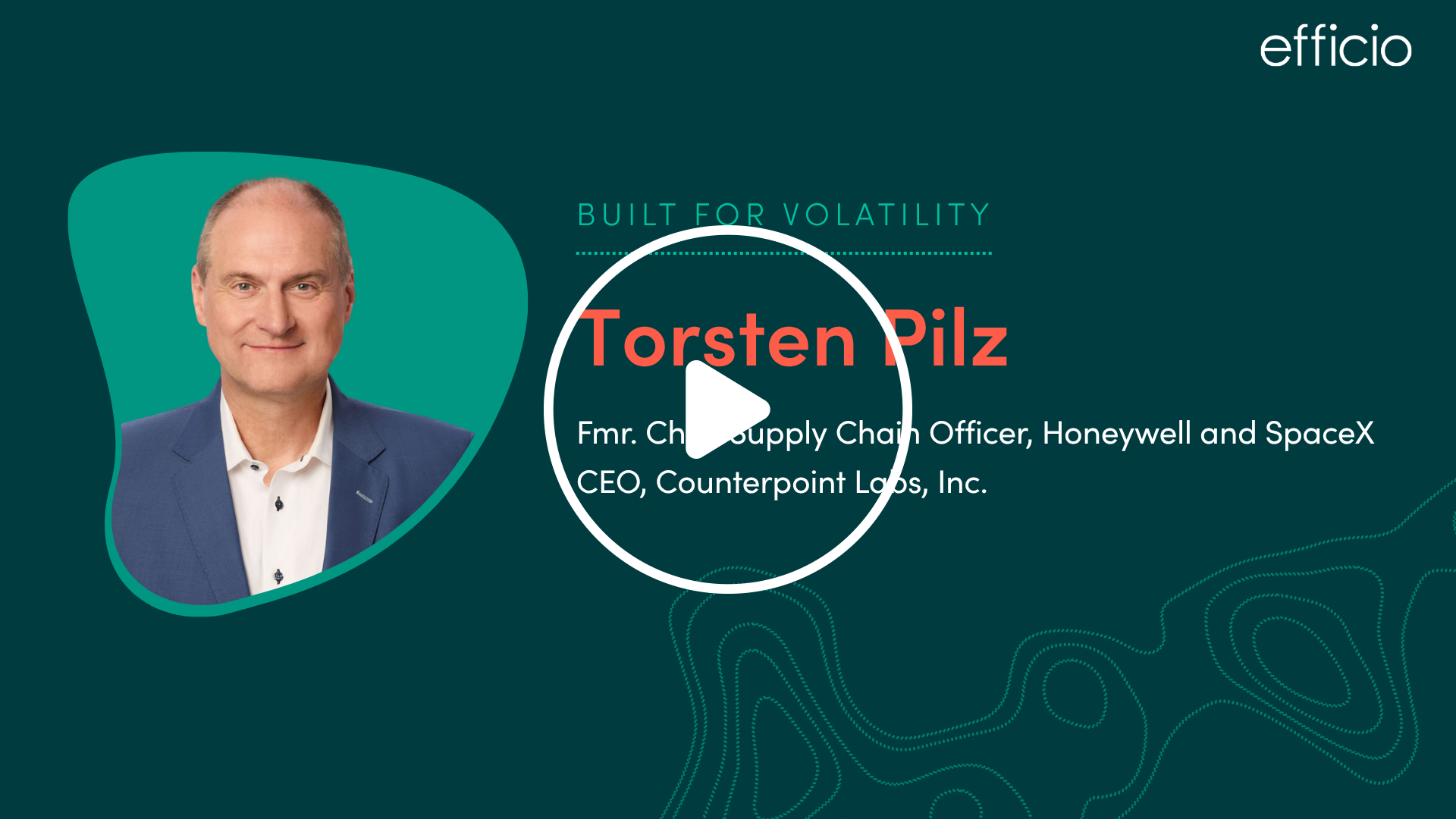
Honeywell’s response to the semiconductor shortage several years ago illustrates that potential. As Torsten Pilz, its former Chief Supply Chain Officer, recalls, the company initially looked for alternative suppliers. But an industry-wide shortage could not be solved through sourcing alone: “You cannot solve this problem with traditional procurement aspects,” he said. Honeywell instead brought engineering, planning, logistics, and procurement together to develop other solutions. Pilz estimates that the company recovered production roughly six to twelve months ahead of many competitors and recalls gaining market share in one product group because Honeywell could deliver when others could not.
For business leaders, the question is therefore not only “How do we protect ourselves?” but “Where does this disruption give us an advantage?”
The commercial value lies in recognising where the organisation can absorb volatility better than competitors and acting on that advantage while the opportunity remains.
Make strategic trade-offs before the opportunity passes
Businesses don't need to predict every disruption. They need to recognise when conditions have changed and make decisions while they still have meaningful choices.
That requires a shared understanding of demand, available capacity, supply constraints, costs, and customer commitments. But information alone isn't enough. The business must also be able to act on it.
Efficio's research highlights this gap. While 67% of executives say their organisations make decisions using a shared view of operational, financial, and commercial risk, only 52% say they can rapidly reallocate resources across functions when disruption occurs.
S&OP or SIOP can provide a forum for resolving these trade-offs, provided it extends beyond routine planning. Leaders need to decide which customers receive constrained capacity, which products deserve priority, where additional investment creates value, and when the business needs to change course.
These decisions cannot wait until the next planning cycle. As demand, costs, and availability change, businesses must continually reassess their options and act while they still have meaningful choices.
How we can help
Efficio helps procurement and supply chain leaders build the capabilities to find, deliver and protect value in volatile markets. Combining deep commercial and operational expertise with data-driven insights and hands-on implementation, we help organisations navigate complex trade-offs, strengthen supply chain performance and turn disruption into opportunity.
Find out how we can helpContact our experts
- Image
-
 Visit Waldo Saville's profile
- Name
- Function
- Vice President
- Visit Profile
- Email address
- Image
-
 Visit Matthew Lekstutis's profile
- Name
- Function
- Director
- Visit Profile
- Email address
- Image
-
 Visit Andrew Black's profile
- Name
- Function
- Vice President
- Visit Profile
- Email address